A lot of people are surprised when they find out I have a pet house sparrow. Though a common bird species across the world, not a common pet. Usually the first question I get is “does he poo everywhere?” Yes, he does, more or less. Sometimes it will be concentrated in areas where he hangs out frequently (such as the top of the bookshelf or behind my computer monitor), but otherwise anywhere and everywhere in his range. He has even gotten poops on the ceiling, though I have no idea how. I’m so used to picking his poo out of my hair or off my keyboard, often it doesn’t even occur to me that other people would probably think this is gross. The next common question I get is, “how did you get him?”
During my last year of undergraduate studies in California (2015), I also worked part-time as a field technician monitoring songbird nest boxes. In my job’s protocol, we had to remove any house sparrow nesting activity we find in the nest boxes, because in North America house sparrows are categorized as an invasive species, meaning they are non-native (house sparrows are native to Europe) and negatively impact other species. In this case, they were outcompeting our target native nest box birds- western bluebirds and tree swallows. On my first week on the job, I came across a nest in one of our boxes with two house sparrow chicks that were only a day old. I didn’t mind tossing out house sparrow eggs (which I did have to do repeatedly for very persistent breeding individuals), but I could not bring myself to dispatch chicks. I decided instead of bringing them to my boss for euthanasia, that I would keep them and provide them a life as house pets.
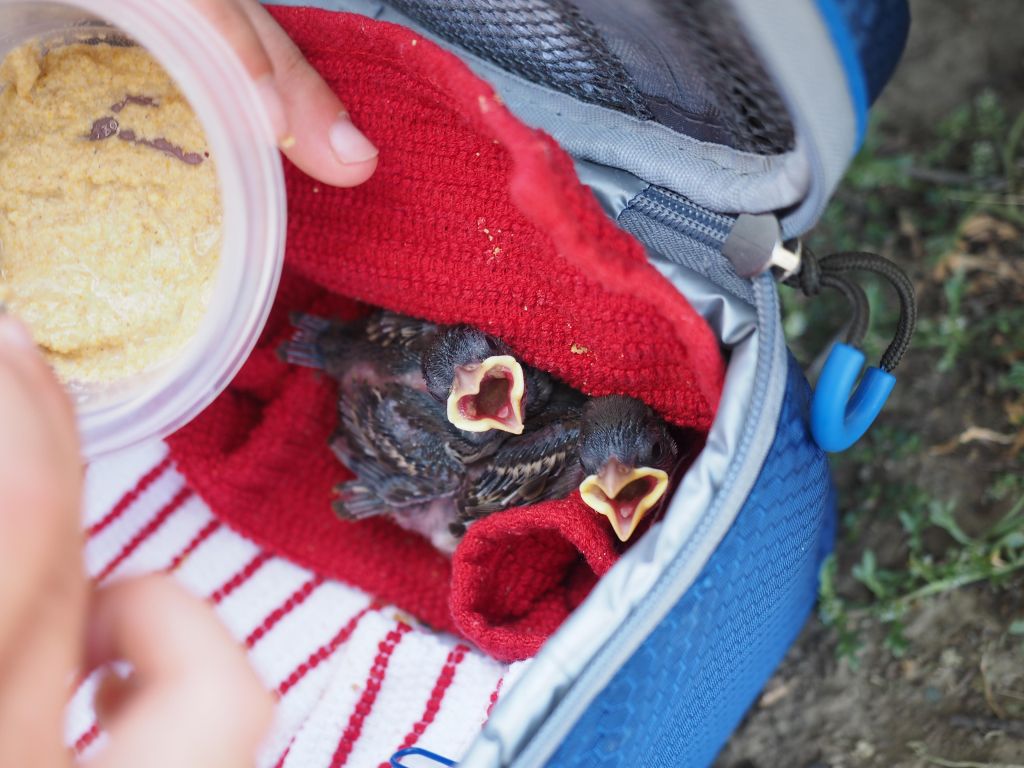
For the first two weeks, I carried the two house sparrows in a blue lunchbox lined with small hand towels, and brought them everywhere I went so I could feed them throughout the day (sunrise to sunset). Using a pair of tweezers to imitate a bird beak, I fed them a fresh mixture of baby bird formula with warm water that I carried in a thermos. At first I fed them every 20 minutes, and gradually increased the intervals (up to 60 min) as they grew older. I would also give them a drop of water on their beaks to hydrate them from time to time. I brought them to class when I could, which was a bit nerve-wracking when I didn’t want to attract attention to their hungry little cheeps- some people thought there were house sparrows in the classroom vents! It was easy to bring them with me to work, where I continued checking more nest boxes and banding birds. During this time in my life I was also visiting my father in the hospital every weekend so I brought them with me when I drove from Davis to the Bay Area. I made rest stops on the drive to feed them, and also took frequent trips between the hospital and the parking garage to continue their feeding routine in the car. The nurses were concerned I had a bladder problem (I had to buzz in every time I entered the ICU), but when I explained my story they were very enthralled by these two baby birds. Once my birds were old enough to be flighty (two weeks old!), I stopped the lunchbox ride and got a cage, which by this time they didn’t need such frequent feedings so I could leave them in my apartment for part of the day. I was relieved that the hardest part was over and the two troopers had grown extraordinary fast. Their fat scores (a metric commonly used when examining birds) were off the charts.
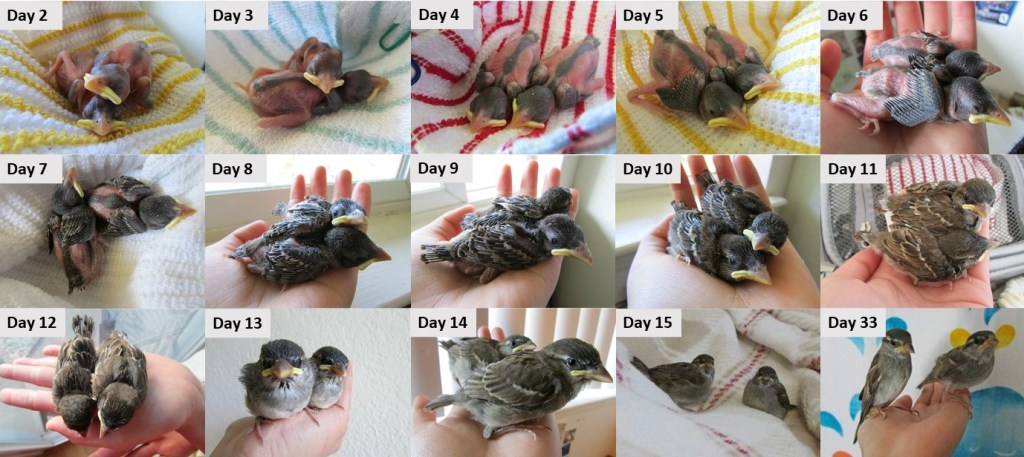
I named them Olive and Opal, thinking they were girls at first. I was naive to how long their juvenal plumage would last, but by the time I saw male colours starting to peek out the names already stuck. Their first flights (day 15) was a quick trip to my shoulder, then around the room. They were so awkward, colliding into the walls of my bedroom while they learned how to use their new wing feathers. As recent fledglings, they still relied on me for hand feeding them for a little bit longer where I continued the baby bird formula and started throwing scrambled eggs in the mix (a very nutritious meal for a bird!). Along with the begging calls they would also now vibrate their wings in excitement for feedings. I tried to wean them off so they could start eating on their own, so I put some corn, peas, and finch seeds on a towel at the bottom of their cage. They didn’t seem interested in them for a long time, but one morning I saw them both sitting together on the food trough and nibbling on seeds! It was the only time I ever saw them sit squished together on the trough. Afterwards they gained confidence to eat on their own, and the finch seeds became their staple food. They also enjoyed spinach (this turned their poo green!), bell pepper, mandarins, and other veggies and fruits. Since Olive and Opal looked alike, I colour banded their legs – Olive with green, Opal with purple. This also came in handy when I babysat three more house sparrows over the summer. My friend Emily faced a similar situation as mine and took in three house sparrow chicks and raised them as well. So, while she was away for a couple months, I had a flock of five house sparrows. Our birds looked subtly different from each other (e.g. her birds had smoother colouring on the chin), but it was nice to have them all colour banded to tell them apart for sure. I let them all roam my bedroom and continued to bring them with me on my travels to the Bay Area on the weekends. Her birds liked to check out Olive and Opal’s cage and eat their seeds, and vice versa – Olive and Opal loved checking out their big cage and seeds too (even though it was the same food!).

Olive, Opal, & friends 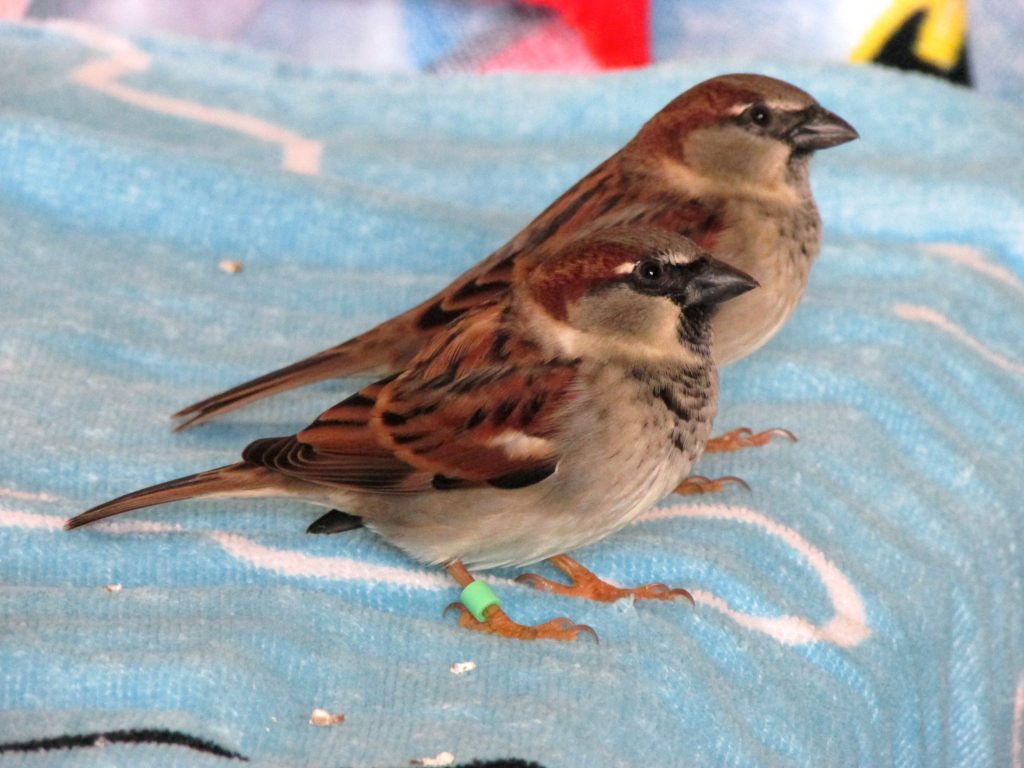
Olive & Opal 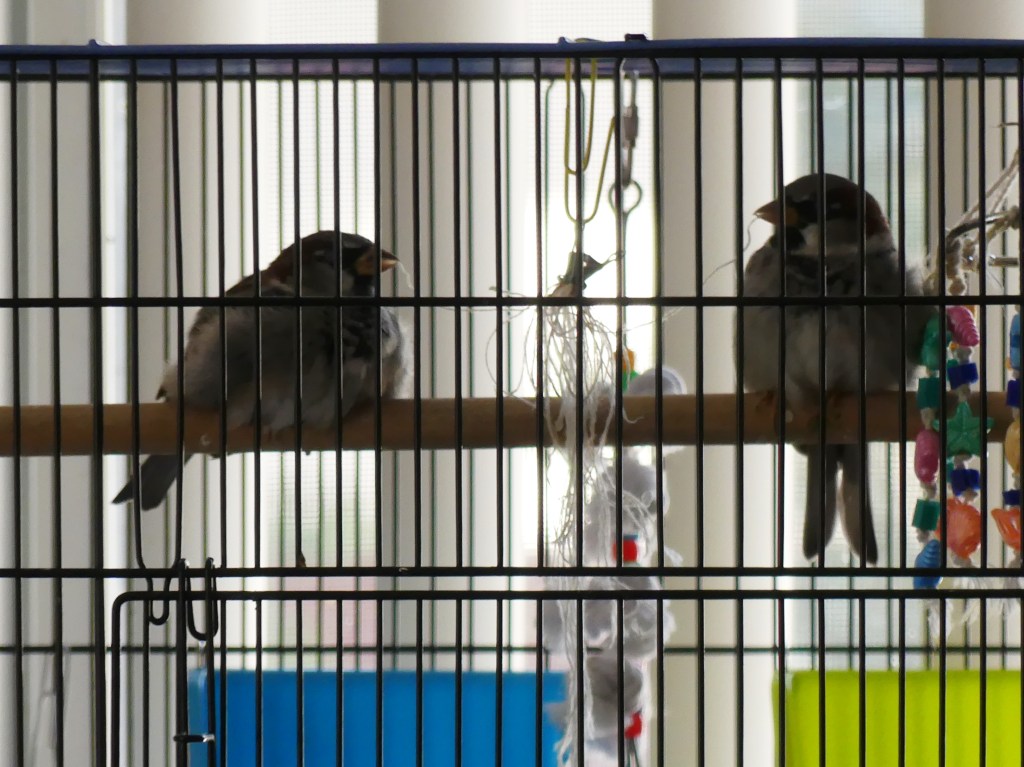
Twiddling string together 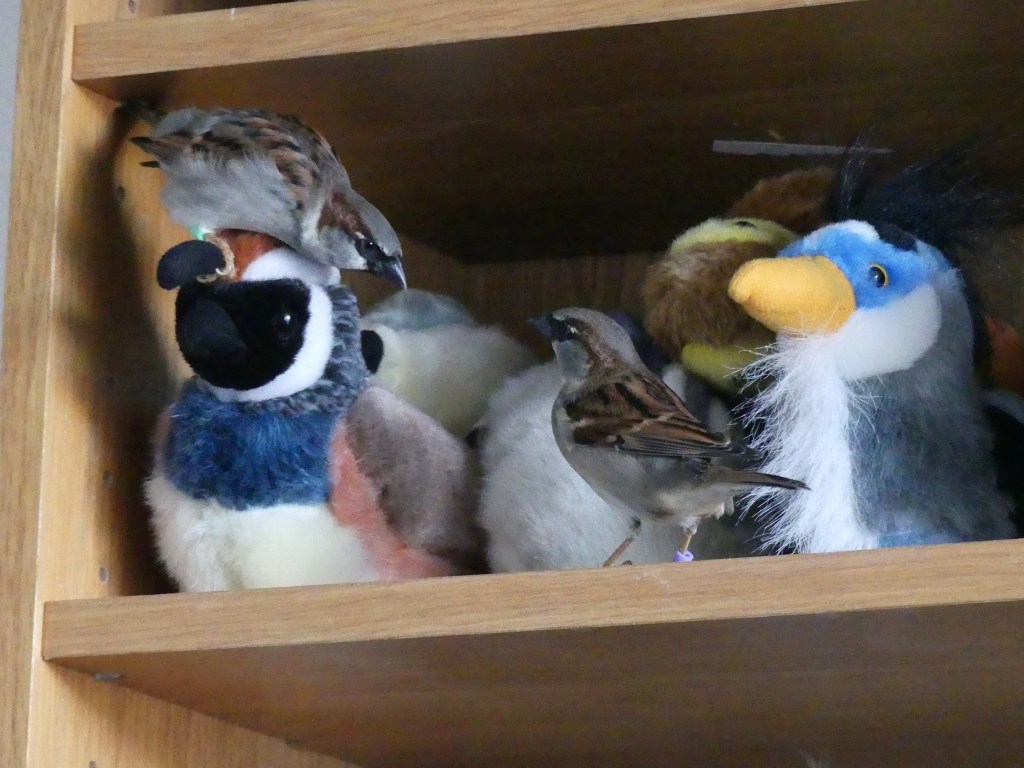
Checking out the bird plushies on the bookshelf 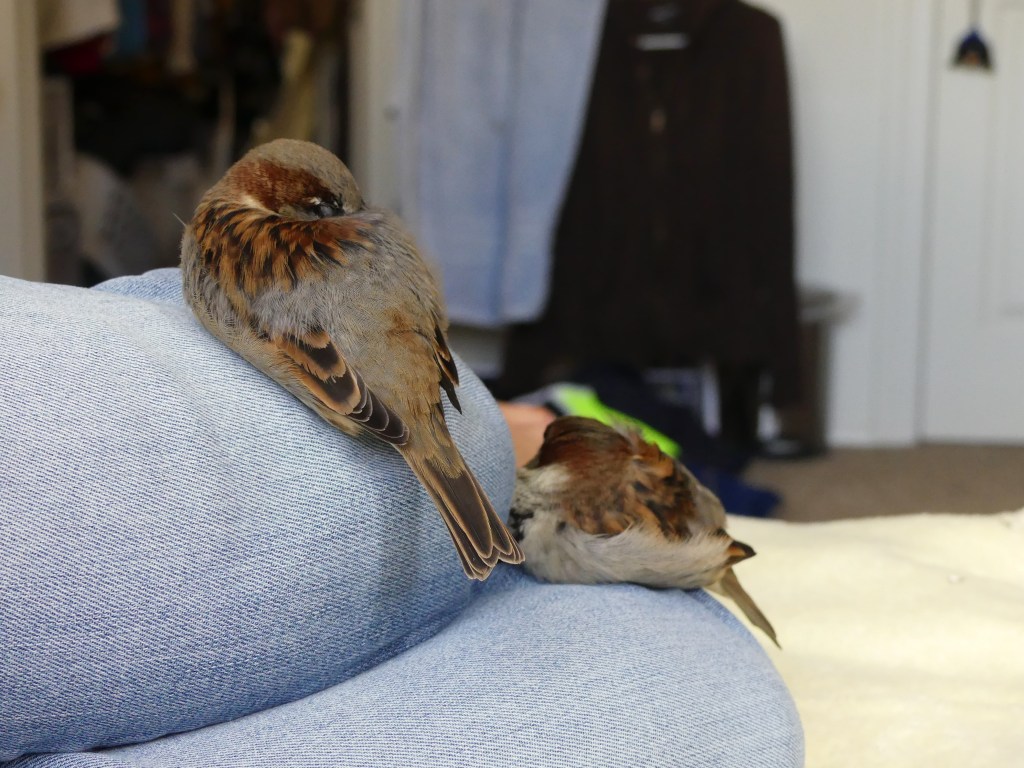
Siesta
When their full adult plumage came in, Olive’s colours were more striking compared to Opal’s. Where Olive had a fully black mask, chin & bib, Opal’s colours were a couple shades lighter. Both were very boisterous in their songs, sometimes mimicking the outdoor birds we could hear by the windows. They loved sitting at the window sill, and I was relieved they never tried to poke the screen open. They also loved to sing when I washed dishes (Opal still does), or when guests were over and talking. Though they would fight frequently, they never harmed each other, and more often they would be hanging out together twiddling string in their beaks like Lady & the Tramp. I believe the string twiddles was one of their favourite ways to bond with each other. They napped on my shoulders or lap, buried themselves in my hair, and sang right in my ear. Most days they would be free in my bedroom, and then I would tuck them back in the cage at night, or earlier if I wanted to bring them out in the living room. In the beginning it was easy to catch them with my hands to put them back in, but they learned to evade me quickly. Olive less so, he was easier to fool with a corn in my other hand. Sometimes I could lure them in with special treats (corn or egg) and avoid any chase & catch, but other times I would have to chase them for a few minutes until they both flew into the cage at the same time. Eventually I just let them stay out of the cage during the night, where they settled themselves in the bookshelf to sleep and then poke my nose in the morning to wake me up. At one point I wanted to introduce them to a bird coconut house/cavity that I thought they’d like. They were absolutely terrified of it at first (not a fan of new things), so I hung it up on the other side of the bedroom from the cage, and everyday I moved it an inch closer. It took me a month to finally latch the coconut house onto the outside of the cage and once they were accustomed to it then I made the jump to put it inside. They weren’t freaking out like before, but they were deathly silent for a whole day. Then soon enough, they loved going in and out of it, hopping on the little bridge attachment, and taking turns to snooze in there. It’s still one of Opal’s sleepy-time spots in the evening.
In the wild, house sparrows would probably live about 2-5 years, dying from predators, disease, and other causes. In captivity they can go over 10+ years, with a record of the longest lived captive house sparrow at 23 years! Pretty amazing for a little songbird. Olive made it to two and a half years – he passed away at the end of 2017. I’m still uncertain at the cause, but he showed prior signs of sickness. He initially got sick when he was under a year old, and I brought him to the vet where I received some antibiotics to give him for a short period of time (putting a drop on his beak to have him drink it). This helped then, but then he got sick the second time around more than a year later. I saved his leg band and then buried him with a couple pieces of corn (his favourite treat) at my favourite spot along Putah Creek.
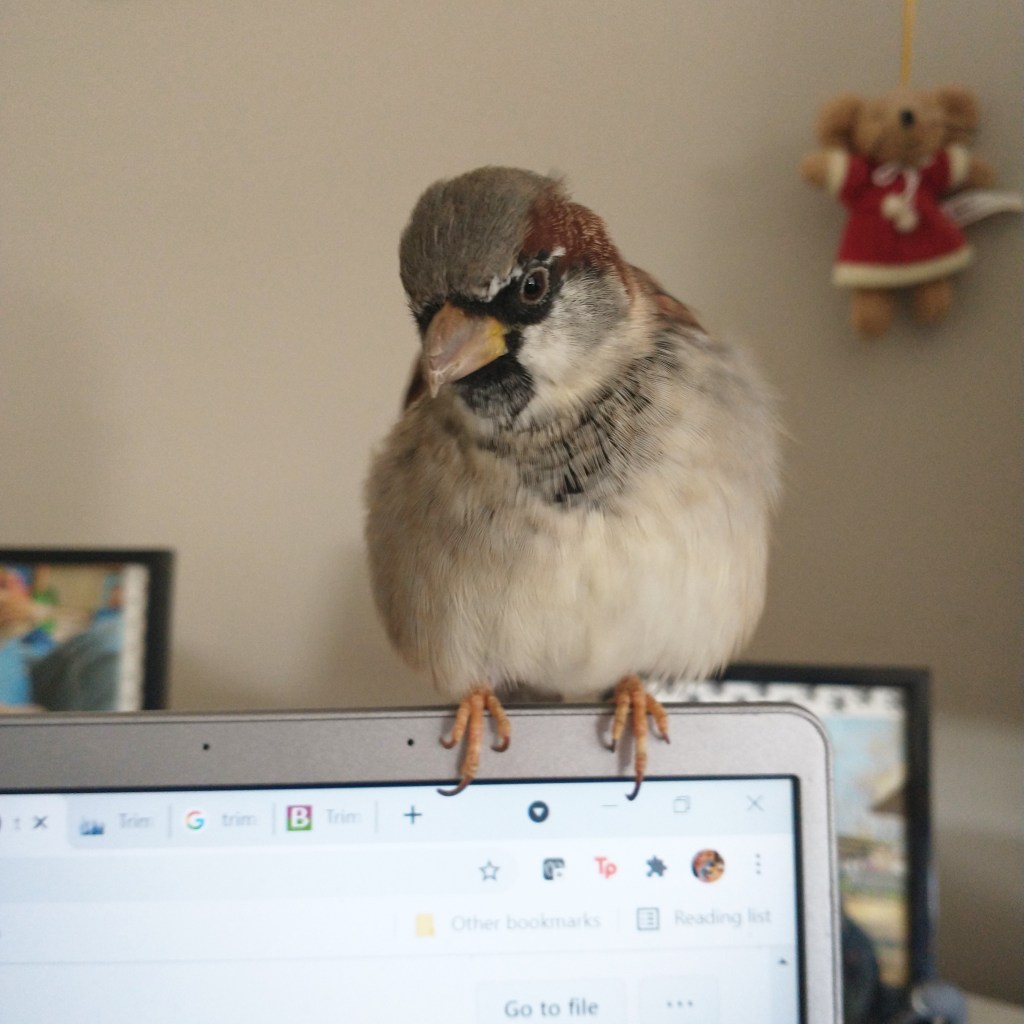
Opal became more affectionate towards me, and interestingly after his next moult he grew in brighter colours, looking closer to Olive’s plumage. I’m not quite sure what caused the shift in plumage brightness, my guess is it could be related to dominance or territoriality, stepping in to make up for the loss of his brother. Or maybe previously his plumage brightness was repressed while Olive had bolder colours? In any case, he was and still is a handsome lad. Opal is the last of his cohort flock, and now at six and a half years old. In 2018, I moved to Manitoba and drove him up from California along with Matt 🧑, Magellan 🦎, and as many belongings I could fit in my car. Ever since moving to Canada, I resumed to tuck him in his cage at night, which has been easy to do with placing a mealworm in the cage. It’s become so routine that he’ll even go in his cage after my little hand signal even if I don’t have a worm! Opal doesn’t play with the lump of string anymore that he and Olive used to fiddle around with together, even though I haven’t moved it out of the cage. But, sometimes he will come to me and twiddle a loose string frayed from the blanket on my bed or the towel on top his cage, and I will twiddle a string end next to him with my fingers to reciprocate. Or he will sit on my shoulder and twiddle my hair in his beak. I believe this is one of his displays of affection. I haven’t really taught him tricks, except one where I put my face up close to him (while he’s out of the cage) and I’ll say “give me a kiss” and he’ll poke my nose with his beak. I used to do this with both Olive and Opal when they were younger every time before I left the room to head out for work or errands. This past year I’ve seen Opal slow down a little, either when he is taking a bath or when I need to chase him to catch for nail trimming (just a few times a year), but he is still full of spunk. He was looking a bit scruffy this past year, even balding at the back of his head and neck, after not moulting for two years. However, I realized I didn’t feed him corn as often as I used to when in California, so I started giving him a couple pieces each day, starting this past August, and soon enough he started moulting and grew in new fresh feathers and is looking great. It’s interesting how a simple veggie in his diet affected his feather growth so much!
Before I came across Olive and Opal, I didn’t realize how many sounds a house sparrow could make, as this species is typically known for a monotone “charp” or bickering chatters. They are actually quite musical! I was also surprised how much they bonded with each other and with people. I believe they both knew they were birds from the start, since they had each other and sparrow friends the first summer. I also believe they can recognize people, especially when differentiating family from guests. Opal is still a bit shy around new people, although he warms up quickly with treats, and he will stand or sit on me first while he inspects others. He also seems more comfortable with people he has already met. Maybe I’m just a crazy house sparrow lady, but I do think house sparrows are quite extraordinary and I find my life much more enriched with them 🐦.
-Evelien
 eveliendegreef.com
May Opal lives a happy long life with you!
LikeLike
Dear Evelien, I loved reading your moving story.I admire your compassion to rescue your birds and courage to bring them along in class, your patience to help your birds safely grow. Love,Dad
LikeLike