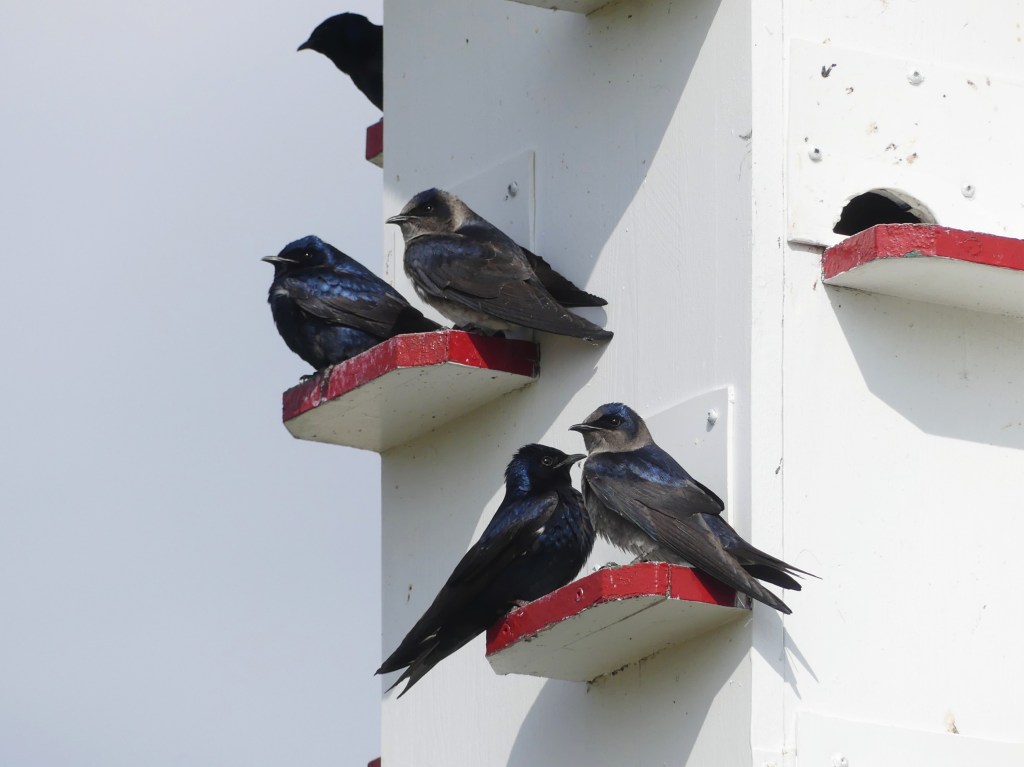
I’m excited to see one of my Master’s chapters published in the Journal of Avian Biology! It is in an open access journal (freely available online), and titled “Population structure, patterns of natal dispersal and demographic history in a declining aerial insectivore, the purple martin Progne subis“. In this paper we studied purple martin population genomics and natal dispersal in North America. Using four sample sites in the eastern P. s. subis subspecies, we found population structure and patterns of isolation-by-distance (where genetic differentiation increases with increasing geographical distance). We also found more longitudinal natal dispersal patterns (going east-east) compared to latitudinal movements, suggesting there may be more gene flow in the longitudinal direction. Additionally, we looked at the three purple martin subspecies to compare demographic histories (changes in effective population time over time) to give us a better understanding of their origins.
This is my first first-author publication, which is a milestone for me. I’m very proud and happy to have this completed, and I also feel very relieved. While I still have another paper from my master’s in review (about migration timing) I already feel lighter and in a better mental state. Unfinished work from my master’s has been a constant buzzing stress the last year and a half, since it’s very difficult to work on a project after feeling burnt out from the thesis work and to find available productive time while working at another job. I’m so happy to complete this project, especially as this paper contributes to purple martin conservation!
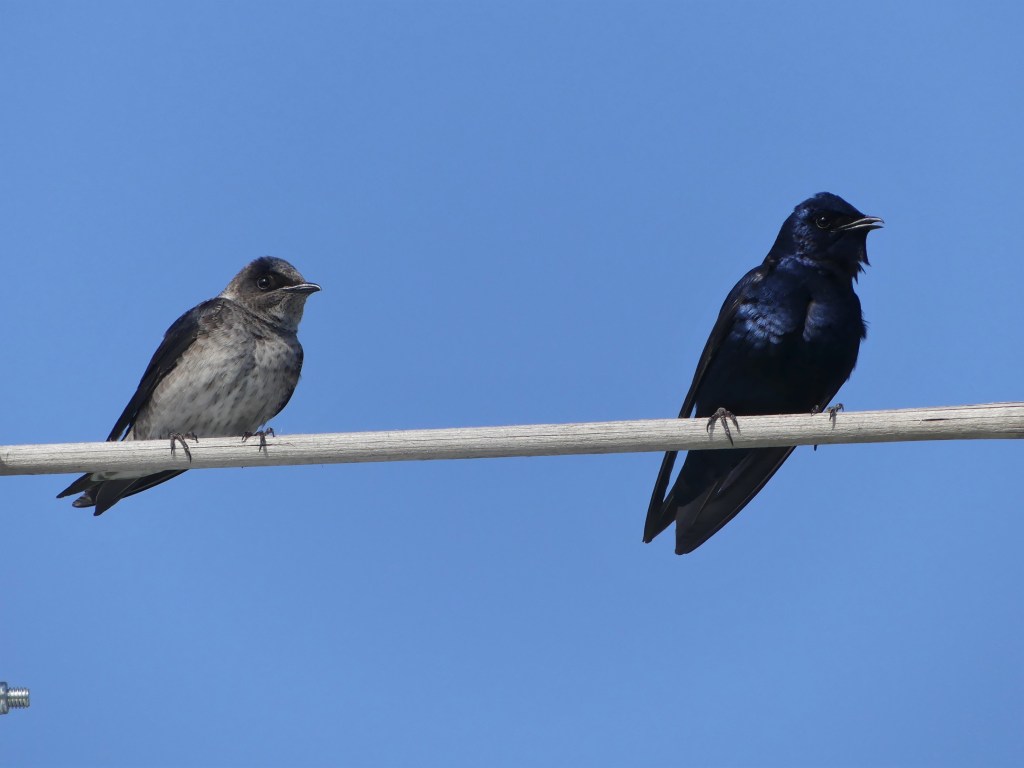
The first time I saw a purple martin was my first summer in Manitoba (2018), joining Dr. Kevin Fraser’s lab for a day in the field before I officially started my program. They’re big swallows! Previously I was used to seeing and handling tree swallows, which are about half the size of a purple martin. One of their most remarkable characteristics, I think, is their colonial behaviour where they breed and roost in large groups, filling the air with large boisterous buzzes and chatters. Even after long migratory journeys from South America to North America, adults tend to return to the same or nearby breeding colony, though each year is a slightly different mix of birds since some disperse (some quite far as we found in the juvenile dispersal patterns!). I joined the purple martin field crew in 2019, monitoring nests, deploying tags, and collecting blood samples – more details in a previous post here. While I’m not involved with purple martin work currently (other than publishing my other thesis chapter paper), they’re always a treat to see here in Manitoba and I’m really fortunate to have had such a great opportunity to work intimately with these fascinating birds.
-Evelien
 eveliendegreef.com